
Small leather goods
A wallet is judged in the hand. Thickness, edge feel, stitch tension and the way a card slot loosens over time decide whether the product feels considered.
Products and constructions
Wallets
Bifold, trifold, long wallet, zip-around and slim card wallets. Interior configurations are built from slot and pocket modules so that card count and note capacity can be adjusted without redesigning the outer.
Card holders
Flat, accordion and pop-up mechanisms. The critical operations are skiving consistency and slot height — a 0.5 mm variation changes how a card feels going in.
Key pouches & coin purses
Zip or snap closure, key hook or chain, leather or textile lining. Small radius curves are the main construction challenge.
Accessories
Passport holders, luggage tags, cable organisers and pouch sets, developed from the same material and finishing system as the main line.
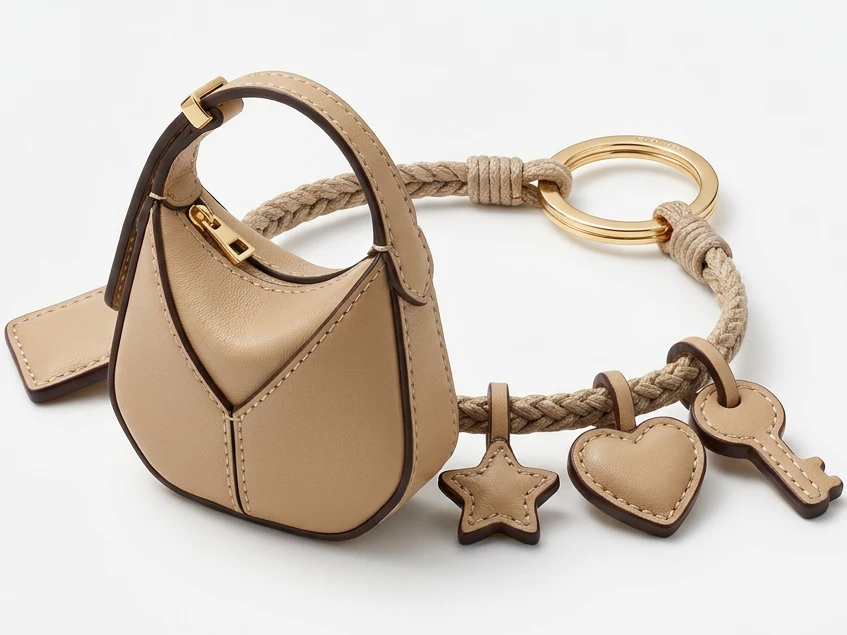
Wallets, card holders, key pouches and belts share the same edge-finishing discipline. Illustrative image.
Small goods are a separate line, not a side order.
Small leather goods carry more operations per square centimetre than a bag: skiving, folding, slot building, edge coating, stitching and pressing. We run them on a dedicated line with operators who work on the category continuously.
That focus is why a wallet can be quoted with confidence and why a new slot configuration does not require rebuilding the whole construction.
Where the quality is decided.
- SkivingPanel edges are skived to a controlled thickness so that folded edges are flat, not bulky.
- Edge paintSanded, primed and coated in thin layers; drying time is controlled, not shortened.
- Stitch tensionThread size, needle size and tension are set per material; the seam should lie flat without puckering.
- Slot alignmentCard slots are stacked and checked against a template before stitching.
- Final pressLow pressure and controlled temperature; excessive heat glazes the leather.
| Parameter | Typical spec |
|---|---|
| Leather thickness | 0.8–1.2 mm body; 0.6–0.8 mm slots |
| Stitch density | 8–9 stitches per inch [TBC] |
| Edge | Painted, creased or burnished |
| Lining | Leather, microfiber or textile |
| Hardware | Zip, snap, key hook, chain |
| Dimensional tolerance | ±1.5 mm [TBC] |
Tolerances are agreed per style; small goods generally require tighter control than bags.