
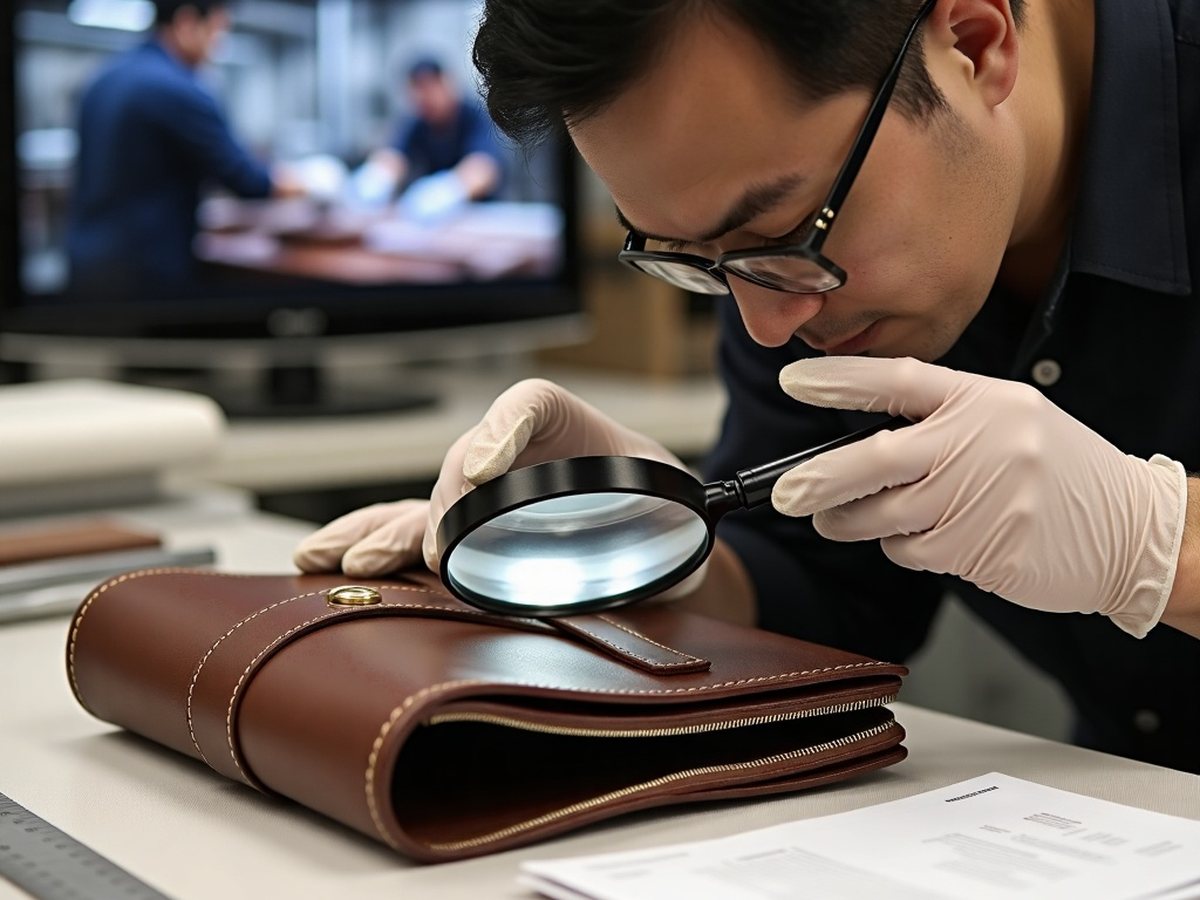
Inspection at the point where defects are created.
Final inspection can only find defects; it cannot prevent them. Our quality plan places checks at incoming, in-line and final stages, with a named owner for each gate.
Quality control at Grand Dragon runs from incoming material checks to final AQL inspection, with photo records and corrective-action logs. Every sealed sample is the bulk production reference.
The documents a buyer asks for.
SMETA audit
Year 2024-2026; certificate PDF available under NDA.
Inspection records
Sealed sample ID, in-line checks and final report with photographs.
Material traceability
Leather batch and hardware records available on request.
Incoming materials
Leather, lining, interlining, thread, edge paint and hardware are checked on receipt against the approved standard: shade, thickness, hand-feel, finish and quantity. Non-conforming material is quarantined before it reaches the line.
In-line controls
Defined operations are checked at the station: cutting accuracy, skiving thickness, panel alignment, stitch density, hardware setting and edge coating. The operator signs off; the line supervisor audits.
Final inspection
Finished goods are inspected against the sealed sample using AQL Level II. Appearance, measurement, function and packing are recorded, with photographs of any defect.
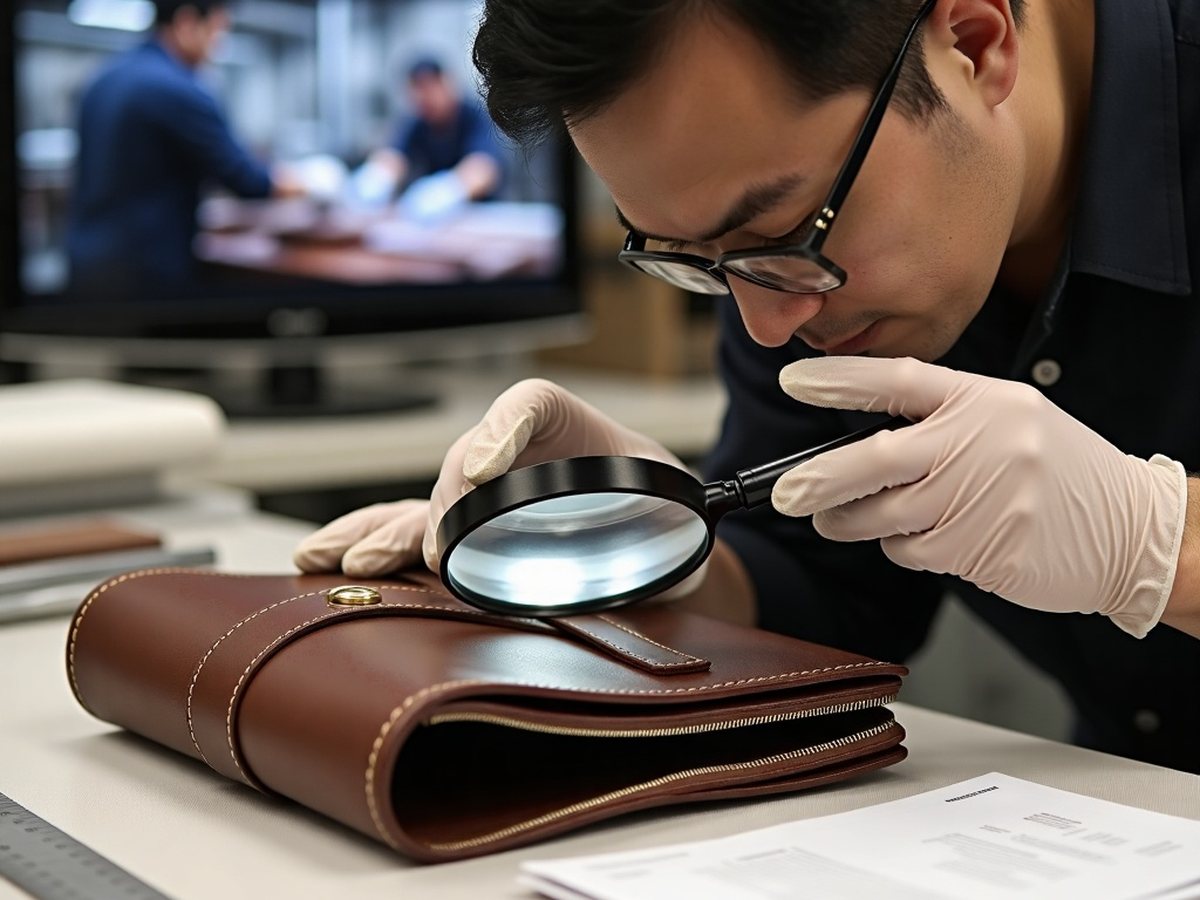
Final inspection measures the product against the sealed sample — not against memory. Illustrative image.
A defect is data, not an opinion.
Defects are classified as critical, major or minor. Critical defects — sharp edges, broken hardware, unsafe attachment — stop the lot. Major and minor defects are counted against the AQL limit and reviewed by category.
Where a lot fails, the corrective action is agreed with the line: rework, re-inspection or rejection. The root cause is recorded so that the same defect does not return on the next order.
- Defect library with reference photographs
- Daily in-line rejection rate tracked by operation
- Corrective action report for repeat defects
- Re-inspection before shipment after rework
| Test / check | Applied to | Method |
|---|---|---|
| Colourfastness to rubbing | Leather, lining | Wet and dry crock |
| Adhesion / flex | Coated leather, edge paint | Flex and peel check |
| Zip cycle | Zips and sliders | Repeated open/close |
| Hardware corrosion | Metal components | Salt spray 24–48 hours |
| Strap and handle load | Bags | Static load on sealed sample |
| Edge paint cracking | Small goods, straps | Bend test |
Testing scope and acceptance criteria are agreed per programme; third-party laboratory testing can be arranged on request.
SMETA-audited, described accurately.
SMETA (Sedex Members Ethical Trade Audit) is an audit methodology covering labour standards, health and safety, environment and business ethics. It is not a certification, and we do not present it as one.
Our manufacturing operation has completed a SMETA audit 2024-2026. The audit examines working hours, wages, freedom of association, health and safety, and grievance mechanisms, and records findings for corrective action.
Customers who require a Sedex membership link or a copy of the audit summary should contact us directly; we share these under the relevant confidentiality terms.
Frequently asked
Can we use our own inspection standard?
Yes. Customer AQL levels, defect classifications and measurement tolerances are written into the inspection plan and applied at final inspection. If your standard differs from ours, we will confirm the difference before quoting.
Do you inspect 100% of production?
Final inspection is normally sampling-based (AQL). Critical operations and high-risk styles can be specified as 100% inspection, with the additional cost reflected in the quotation.
Who pays for third-party inspection?
Customer-appointed third-party inspections are welcome. The cost is normally borne by the customer; we provide access, space and documentation.
What happens if a lot fails?
The lot is held. We agree rework or re-inspection with the customer, record the root cause and re-inspect before shipment. Where a failure is our responsibility, the cost of rework is ours.
What is AQL 2.5, and is that what you use?
- Where do edge-painting defects usually come from?
- Curing, not painting. Each layer dries through before the next — that is where the rejects are caught.
- Is material traceability available?
- Yes — leather batch and hardware records can be attached to the shipment file.
- What happens to a failed inspection?
- A corrective-action record is logged to the lot, and re-inspection follows the same AQL plan.
Need our quality documentation?
Inspection templates, defect classifications and audit summaries are available under confidentiality.